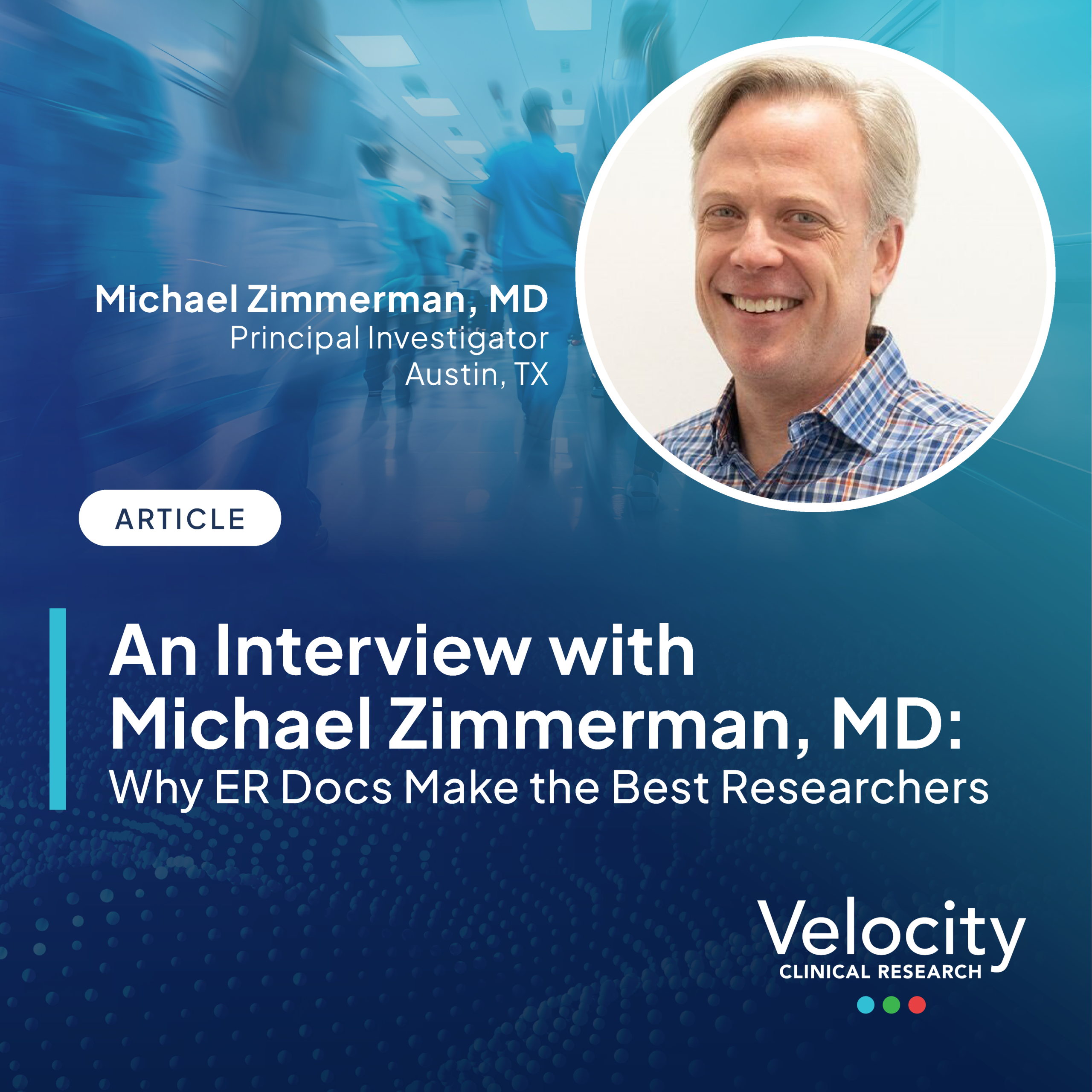
Michael Zimmerman, MD, will tell you that he is impatient, with about as much fanfare as someone might mention they’re left-handed. He chose emergency medicine partly because of that trait: the ER moves fast, emergency medics get to travel in helicopters, and nobody makes you wait two days for a lab result. That fast-paced world defined his life for over 25 years, starting in Chicago and then for the past 14 years in Austin, Texas.
Now, he runs a clinical research site for Velocity Clinical Research in Austin, TX, where trials can take years and the closest he comes to a helicopter is seeing one skim the skyline. He works Monday through Friday, has holidays off, and a regular bedtime. And he finds it more sustaining, and more scientifically satisfying, than anything he has done before.
The Long Way Out
Getting here was not straightforward. By the time the COVID pandemic swept through the ER, Dr. Zimmerman had been doing full-time emergency medicine for almost 25 years. He describes coming home one day and feeling completely drained. His wife said it was time to find a new job, and he agreed.
What followed was a search that could have gone many different directions, and by all accounts shouldn’t have been quite as fast or easy as it was. He found a website called The Doctors Crossing, which helps physicians reframe their skills for careers outside clinical medicine. Unsure what a future outside the ER looked like for him, he took the next logical step and posted on a car forum (he is a serious car enthusiast; ask him what he loves most about Texas, and the roads feature prominently).
His post asked whether anyone knew of opportunities for an ER doctor looking for a change. Responses came in from people with family in pharma, from recruiters, from a retired physician placement specialist with 25 years of experience finding non-clinical roles for doctors. In their third conversation, that contact mentioned a company called Velocity Clinical Research. The office was eleven minutes from Dr. Zimmerman’s front door, and they needed a Principal Investigator.
“The role literally fell into my lap,” he recalls. Even so, he didn’t take it on faith. He found J. Scott Overcash, MD, Site Director and PI at Velocity’s San Diego site, on LinkedIn and asked for a call before committing. That conversation turned into an ongoing mentorship. “We still check in, even four years later,” he says.
Why ER Doctors Make Good Researchers
Emergency physicians, by the nature of the specialty, know a little about almost everything: cardiology, endocrinology, neurology, pediatrics. You cannot run an ER without coming across all of it. That breadth is exactly what a busy multi-therapeutic-area research site needs.
“There’s almost nothing you can’t do,” Dr. Zimmerman says of the ER-to-research transition. “We’re jacks of all trades in the ER, so I’m comfortable taking care of just about anything.” His site currently runs a mix of cardiometabolic, diabetes, and cholesterol trials, alongside seasonal vaccine work, without missing a beat between them.
It’s clear from just a short conversation that he enjoys how patient-centric his current workload is. “It’s gratifying to help people change their lives for the better and help advance science for everyone,” he says, recalling a patient who reported that he’s in the best shape of his life and able to be more active thanks to a GLP-1 trial.
He’s also enjoying the academic rigor of research. Before medical school, he completed a master’s degree and spent time doing basic bench research. The rise of mRNA therapeutics and gene-silencing technologies has given him reason to dust off knowledge from graduate school that felt distant during decades of emergency medicine. “I get to kind of relearn all of that,” he says. “And that’s pretty fun.”
The Study That Meant Something
Ask him what he’s proudest of at Velocity and he doesn’t hesitate: a trial examining the link between hypercortisolism, elevated cortisol, and difficult-to-control diabetes. The first phase was essentially a screening exercise, and the finding surprised him — roughly 20% of patients with poorly managed diabetes turned out to have hypercortisolism.
“Like many ER doctors, I’m a cynic,” Dr. Zimmerman confesses. “And when people told me they did everything right but their results didn’t show it, I doubted them. So being part of the front line, finding out that some of these folks were absolutely right, they could follow their treatment plan to the letter and still see no benefit, was humbling.” That instinct to question a result before accepting it, he says, is something the ER trains into you permanently.
He describes one participant with ten years of continuous glucose monitoring data, who had done everything right and still could not get his numbers under control. During the study, his blood sugar normalized. He lost 25 pounds. He called Dr. Zimmerman to say it had changed his life. “We’ve seen some people really change. They get the help they need to completely transform their lives,” he says. “That is very different from what happens in the ER.”
A Sustainable Model
He still works two shifts a month in emergency medicine, mostly to keep his skills current. Austin suits him: it’s a major music city, and the Texas Hill Country is just west of town when he wants to drive through the state’s varied landscapes. Nothing, he says, beats the friendliness and hospitality of Texans.
But the shape of his professional life has shifted in ways that would have surprised him just a few years ago. He had assumed for years that a Monday-to-Friday office existence would feel monotonous. Fresh out of his emergency medicine residency, he would joke that he would “shrivel up and die” doing a nine-to-five. “Now I’m like, this is awesome,” he says. When the alternative was ten more years in the ER and 300 more night shifts, regular hours started to sound pretty appealing — and so did the idea of a research site built by people who know what it takes to get a result right, the first time.