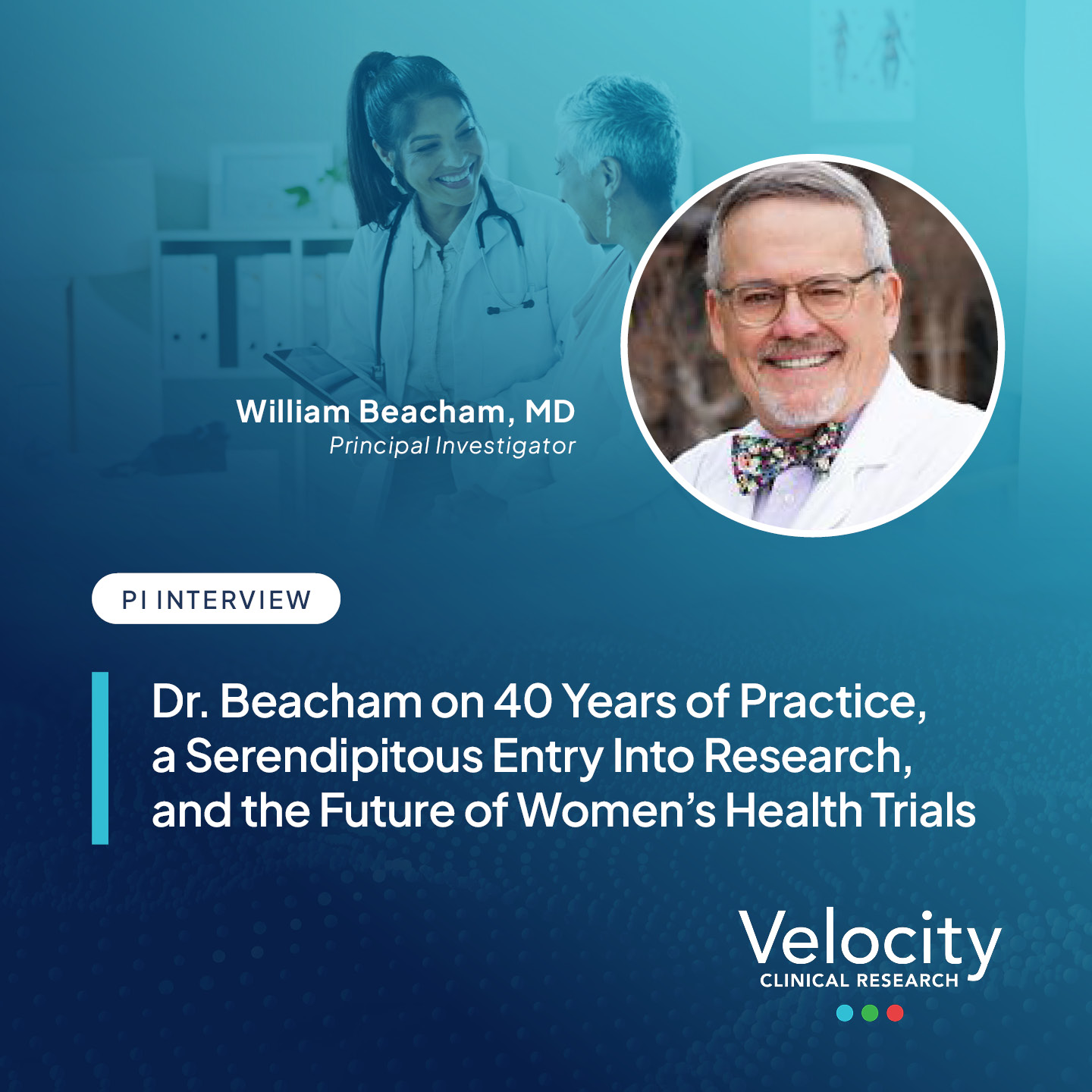
There is a phrase William Beacham, MD reaches for when people ask how he ended up an OB-GYN: congenital gynecologist. It was his father’s speciality, too, and his grandfather was a physician. Four of his father’s five brothers also went into medicine.
So, by the time Dr. Beacham was making his own choices, there was a certain pull towards clinical medicine, and he went with it. What he could not have anticipated was that, four decades later, a chance visit from a research representative would see his career diverge slightly from that of his father and grandfather.
Forty Years, One Practice
The career that preceded that visit was, by his own account, an unusual one. Dr. Beacham spent forty years in the same OB-GYN practice in Louisiana — something he notes is rare in the United States — helping it grow from a small group to seven physicians and a team of certified nurse midwives. They were among the first practices in the state to formally incorporate midwifery.
At their busiest, the practice was handling between 120 and 160 deliveries a month, serving patients from all walks of life, “We had Medicaid patients and the wives of bankers all in the same waiting room,” Dr. Beacham tells me proudly.
While his father influenced his interest in OB-GYN, the real appeal of the specialty was the arc of the patient relationship, the opportunity to support women through every stage of life, from adolescence to conception, pregnancy, birth, postpartum, and menopause.
As the years passed, he naturally moved away from obstetrics and surgery to focus on office gynecology. “I was aware that my time in clinical practice was drawing to a close,” he recalls, “And I was beginning to wonder what the next chapter might look like.”
An Unexpected Turn
That chapter surreptitiously arrived in the form of a Velocity rep recruiting for a maternal RSV vaccine. “I’d never really considered clinical research before,” says Dr. Beacham, “But the opportunity to protect children in the first year of life from common diseases was a clear advantage, and I knew from my practice what a difference that would make.” When a Principal Investigator position later became available at Velocity’s Covington practice, Dr. Beacham jumped at the chance to move into research.
By his own admission, Dr. Beacham was naive about what the role entailed, but he threw himself into it. He was guided by the current Site Director — herself a Women’s Health Nurse Practitioner — and happily spent his weekends perusing protocols.
“Within a year of joining Velocity, I went from part-time PI to a full-time PI and Medical Director,” he recalls, “The learning curve was steep, but the intellectual component — really getting into a protocol, understanding its design — is something I genuinely enjoy.”
Sponsors, he came to understand, bring physicians into the process precisely for their clinical judgment, the ability to read a protocol, identify potential friction points, and say so clearly. It’s one of his favorite parts of the job, leveraging decades of clinical experience to advise on protocol design.
Developing Covington
The Covington site has a natural Women’s Health focus, thanks in part to the background and experience of the team there. But Dr. Beacham is quick to point out that they cover far more therapeutic areas. “We run vaccine, cholesterol, atopic dermatitis (eczema) studies, and more… I enjoy the diversity,” he says, “and the opportunity to expand my knowledge beyond OB-GYN.”
The nature of the network (Covington is one of over 70 sites in Velocity’s global network) lets Dr. Beacham focus on the aspects of the role he enjoys the most. “The centralization of processes like contracts and budgets saves me hours at my desk,” He explains, ruefully acknowledging the administrative burden that used to be a PI’s lot. “It gives me the time back to focus on my studies and participants.”
He has also become an active voice in Velocity’s Women’s Health CARE Council, which brings together women’s health specialists to share best practices and provide early input to sponsors on protocol design. There’s also a group chat for each study running across multiple sites, where CRCs, PIs and sub-Is can discuss trials and share learnings. “It’s a great support,” Dr. Beacham says with a twinkle in his eye, “I just have to be careful about the jokes I share in there.”
Understandably given his background, it’s Women’s Health trials that he watches most closely. He knows firsthand the impact a contraceptive patch or maternal vaccine could have, and he’s delighted to see these trials come through. “Women’s Health doesn’t always get the attention it deserves,” He notes, “But I do think there’s a modest shift underway. At least, that’s the impression I get from our pipeline.”
Looking to the Future
Talking to him, it’s clear Dr. Beacham cares passionately about his work and his patients. And while I’m sure many in Velocity know him as the joker in the group chat, he clearly takes very deliberate care of those around him. He talks about his site team with a familial warmth (and pride), and very obviously enjoys the time he spends with both colleagues and patients.
He’s about to onboard a partner from his clinical practice as a new Covington PI, a hospitalist who will eventually take over from him when he steps back in a couple of years. “It’s good to have a plan,” he affirms, “It sets us all up for success.”
It’s very clear that, for Dr. Beacham, there’s always a plan. This is the career he chose, built, and will eventually pass on with the same kind of deliberate care he takes of everything else. A congenital gynecologist he may be, but every step of his career so far has clearly been very carefully considered.