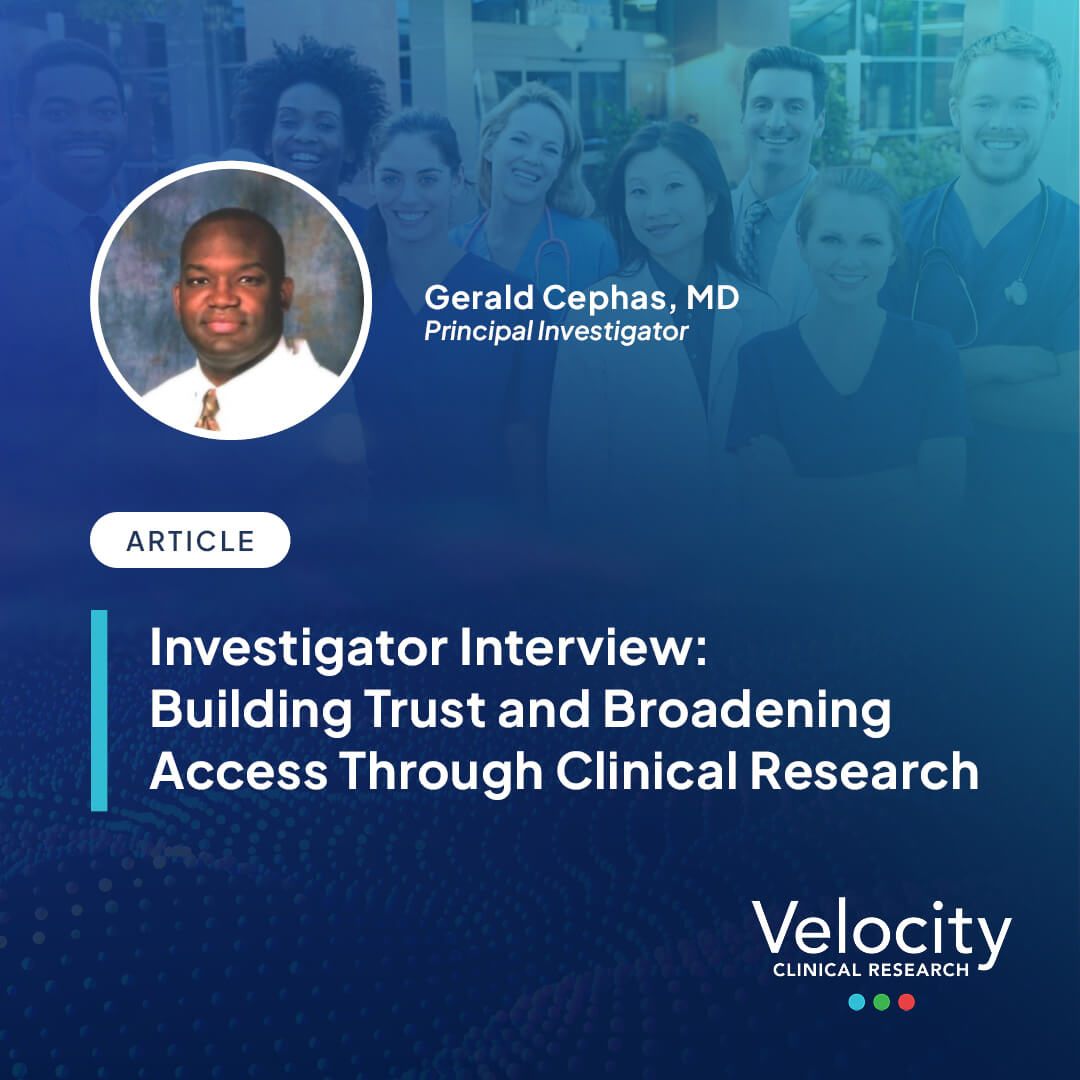
A research career wasn’t part of Gerald Cephas, MD’s original plan. He trained in general surgery, intending to specialize in pediatrics, but a health setback during residency changed his course. “Toward the end of residency, I got sick,” he explains. “So, long story short, research presented itself as a Plan B, and I’ve been on that track ever since.”
It didn’t take long for that Plan B to become something more purposeful. “I went into medicine to take care of people, not to manage administration,” he says. “In clinical research, you obviously still follow a protocol, but your medical judgment is trusted. If I say a patient needs a particular test, Sponsors will generally agree.”
That trust in his judgment — and the directness of the research — appealed to him after years of seeing how traditional healthcare can get tangled up in paperwork and procedures. “There are underserved communities that don’t get the medical attention they need,” he notes. “Research is a way for them to actually be seen by a doctor and make sure there aren’t major medical problems they need to deal with. It’s not ideal, but the availability of clinicians in research allows people to receive at least some medical checks and put their minds at ease.”
Dr. Cephas sees research as a practical tool for change. Community-based sites, like Velocity’s Cleveland site, can reach populations that traditional healthcare sometimes misses. “Sites are part of their communities. That matters,” he says. “They can help rebuild trust, particularly in groups that have good reason to be cautious of medicine and clinical research.”
The value of his work is a common theme, though Dr. Cephas seems to be painfully aware of how much further there still is to go. He shares a personal story about a family member who didn’t receive a complete diagnosis until their condition was advanced. The lesson that experience reinforced for him is clear: marginalized groups are still at a disadvantage when it comes to medical treatment and research. “It shouldn’t happen in 2025,” he says simply. “We’ve come a long way, but we still have a long way to go. As investigators, we have a role to play in making sure trials are representative.”
Decades of Psychiatric Research
Dr. Cephas is definitely doing his bit. A specialist in neurology and psychiatry, he has participated in more than 50 studies in schizophrenia, a similar number in bipolar mania, and around 75 in depression, including treatment-resistant cases.
Psychiatric studies require a particular sensitivity. Enrolling and supporting patients with depression or mania is markedly different from other treatment areas and demands empathy, structure, and safety. “It’s a privilege to be able to make a difference in people’s lives. Knowing that treatments I’ve helped test are now approved and helping people every day is incredibly rewarding.”
Network Collaboration
When Dr. Cephas joined Velocity in 2022, he brought with him extensive psychiatric experience. This has been leveraged across the network, and he’s an important member of the Central Nervous System CARE Council, helping advise on best practice and protocol development.
“I love working closely with Dr. Safirstein, who leads the council,” He explains. “She’s got so much going on and is full of energy and enthusiasm!”
“One of the council’s roles is to make sure the network has the capacity to do some of these trials, looking at sites and whether they have people with experience in Alzheimer’s, Parkinson’s disease, or psychiatric conditions. It’s a new experience for me since working with Velocity, and I think it’s a good idea.”
Dr. Cephas has worked in multisite clinical research organizations before, but he’s quick to point out that Velocity is on a different scale entirely, with sites all over the U.S., U.K., and Europe. “The network has people from every specialty at their disposal,” He explains, “So we’re able to be involved with studies from a number of different indications, with the support of genuine experts.”
“There are a lot of advantages we can offer Sponsors.” He continues, “Consistency across the board: similar processes, similar ways of data collection and documentation, similar regulatory and startup processes. I think this model is the way to go, really.”
Finding a Home
Joining Velocity meant Dr. Cephas had to relocate to Cleveland. He did so mid-pandemic with no prior knowledge of the area. Luckily, he and his partner have stumbled on a city they genuinely love.
“It was a lucky pick,” he laughs. “I chose it remotely, but it turned out perfectly.” He speaks warmly of the music, food, and cultural life of Cleveland, from the Orchestra at Severance Hall to summer concerts at Blossom and theatre at Playhouse Square. It’s clear from even a short conversation that he’s very settled, both personally and professionally.